

Sepsis and systemic inflammatory response
Systemic inflammatory response unleashed by sepsis or induced by a sterile endogenous insult, is a key phenomenon that often characterize the critically ill patient admitted to an intensive care unit. This includes a wide range of aetiologies; abdominal sepsis, toxicities related to haematologic treatment of patients, thrombo-ischemic events, and acute respiratory distress syndrome (ARDS) featured by complex pathophysiology involving the inflammatory cascade, lung mechanics, and systemic and pulmonary circulation.
This project aims to characterize inflammatory patterns and trajectories for different disease conditions or subgroups in heterogenous syndromes as ARDS. Furthermore, to reveal inflammatory targets that are promising for biomedical intervention.
The complement system plays a key role in innate immunity. The innate immune system and complement recognizes danger associated molecular patterns (DAMPs) during tissue damage in different diseases. In addition, they recognize pathogen associated molecular patterns (PAMPs) on bacteria and other pathogens. Biomaterial surfaces and cholesterol crystals may act as DAMPs. Cholesterol crystals accumulate in the wessel walls in atherosclerotic plaques. Cholesterol crystals acts as DAMPs and activate complement and innate immunity inducing the release of cytokines. Cholesterol crystals and some cytokines may upregulate Tissue factor on human whole blood monocytes which activates coagulation. The project examines the role of complement and FXII in the inflammation and coagulation activation induced by cholesterol crystals, bacteria and biomaterial incompatible surfaces. Studies on the role of the complement in the regulation of long-non coding RNA (lncRNA), mRNA and different small RNAs are also performed in fresh human whole blood. By using specific complement inhibitors and a specific FXII inhibitor the role of specific complement proteins, receptors and FXII in inflammation can be studied.
Main goals:
- Examine the role of complement and FXII in cholesterol crystal-induced inflammation and coagulation activation
- Examine the role of complement and FXII in biomaterial surface-induced inflammation and coagulation activation
- Examine the role of complement in bacteria-induced regulation of lncRNA, mRNA and small RNAs
Several studies indicate that activation of complement is involved in inflammation, tissue damage and coagulation activation in myocardial infarction, ischemic stroke and sepsis. Urinary tract infections and bacterial infections in the lungs are known risk factors for venous thromboembolism (VTE) including deep venous thrombosis (DVT) and pulmonary embolism (PE). The complement system interacts with several other cascade systems including the coagulation and the fibrinolytic systems. Both complement and coagulation are activated when the bacteria get in contact with blood in sepsis leading to inflammation and coagulation activation ranging from coagulation disturbances to disseminated intravascular coagulation (DIC). We have developed different models using fresh full human blood to study the mechanisms involved in complement induced activation of inflammation, coagulation and platelet activation. In the main model we use the anticoagulant lepirudin which do not affect complement activation. By adding different Gram-positive and Gram-negative bacteria and specific inhibitors of complement, CD14 and TLRs we can study how complement activation and TLRs are involved in bacteria-induced inflammation, activation of coagulation and blood platelets.
Main goals:
- Study the relative role of complement, CD14 and TLRs in bacteria-induced activation of coagulation and blood platelets
- Study the relative role of contact activation and FXII in bacteria-induced activation of coagulation and blood platelets
- Analyze biomarkers of complement activation and related biomarkers for inflammation in a clinical study on venous thromboembolism in cooperation with others
Biomaterials are essential components of modern medicine and include medical devices, implantable materials, nanoparticles, extracorporeal circulation systems, and emerging regenerative therapies. Upon contact with blood and tissues, biomaterials are immediately recognized by the host, triggering a cascade of thromboinflammatory reactions involving complement, coagulation, platelets, leukocytes, and endothelial cells.
The biological response to biomaterials is governed by a complex interplay between material properties and innate immune recognition. By understanding these mechanisms, we can identify strategies that improve biocompatibility, reduce adverse inflammatory reactions, and enhance clinical performance. We therefore aim to identify (i) which material characteristics drive adverse host responses, (ii) which biological pathways are responsible for biomaterial-induced thromboinflammation, and (iii) how these pathways can be modulated to improve patient outcomes.
Current projects:
- Complement activation and thromboinflammation induced by blood-contacting biomaterials using human whole-blood models.
- Protein corona formation on nanoparticles and biomaterial surfaces and its impact on innate immune recognition.
- Biocompatibility assessment of medical devices and extracorporeal therapies, including strategies to reduce inflammatory complications.
- Endothelial responses to biomaterials, investigating mechanisms regulating vascular compatibility, inflammation, and tissue integration.
- Development and evaluation of novel approaches to improve biomaterial biocompatibility, including surface modifications and targeted inhibition of thromboinflammatory pathways.
Hereditary angioedema with C1 inhibitor deficiency (C1-INH-HAE) is characterized by relapsing, non-pruritic swelling in skin and submucosal tissue. Symptoms can appear in early infancy when diagnosis is more difficult. In the absence of a correct diagnosis, treatment of abdominal attacks often leads to unnecessary surgery, and laryngeal edema can cause asphyxiation. A cohort study of 52 patients from 25 unrelated families in Norway was studied and we discovered a deep intronic mutation: c.1029 + 384A > G, in intron 6 which is responsible for HAE type I in a large Norwegian family in 2017, but have not yet published it.
The same mutation was published in 2020 by a group from the Czech Republic
It has been recognised that the activation of protein C by thrombin, when thrombin is bound to endothelial cells, is a powerful anticoagulant event, leading to cleavage of FV and FVIII. Protein S is cofactor for protein C, but can probably also inactivate FXa directly. Protein S is bound to C4BP, which also binds the split product C4b of the complement system, but only on distinct chains. It is believed that these bindings are independent of each other. HAE patients have a continuous breakdown of C4 and, theoretically, would be expected to load the C4BP with increased amounts of C4b correspondingly. Interestingly, case reports of functional protein S deficiency in HAE have been published, although the mechanism is unexplained.
We investigate the breakdown of C4 in C1-INH deficient patients further.
Bradykinin is an important mediator in blood pressure regulation, ischemic precondition and capillary leakage, allergy, anaphylaxis, inflammation, and nociception, at least partly via the generation of nitric oxide (NO). Macrophages are particularly abundant in the porcine lung circulation. Upon bradykinin binding macrophages release cytokines and endothelial cells increase plasma leakage. Both cells produce NO. The complement, hemostatic, fibrinolytic and kinin plasma cascade systems crosstalk and interacts with many inflammatory systems. In the present study we investigated the effect of the shock induced by intravenously infused bradykinin on the cascade systems, cytokines, plasma leakage and exhaled NO in pigs. The metabolite of bradykinin, BK1-5, was measured in plasma by a sensitive, specific and reliable liquid chromatography-mass spectrometry method to verify exposure and in vivo metabolism of bradykinin. We show for the first time in vivo how bradykinin exposure induced shock and increased exhaled NO, activated complement and hemostasis and induced cytokine production and capillary leakage. The results broaden our understanding of how bradykinin activates endothelial cells and macrophages to induce shock and inflammation. Read More
We plan further studies!
Pain (Dolor) is central to Inflammation.

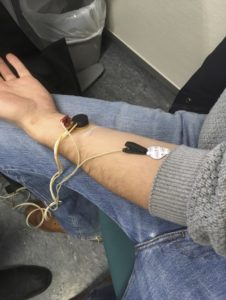
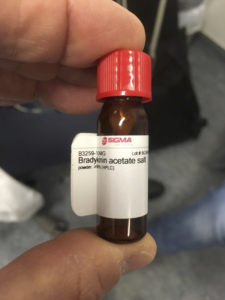
Bradykinin is considered an important mediator of pain. At least some of its effects are via transient receptor potential vanilloid 1 (TRPV1), a heat-sensitive ion channel (DOI).
We investigate the role of exogenously applied bradykinin in iontophoresis in various settings.
Eculizumab, a monoclonal antibody targeting and preventing cleavage of C5, is FDA approved for only four rare conditions. However, complement is suggested to play a key role in numerous other disease entities and during the last 10 years a growing medical knowledge, faith and willingness to adopt complement inhibitory therapy to other patients groups is evident.
This project aims to reveal novel insight into pathophysiological processes of different human diseases where complement plays a key role. Antiphospholipid syndrome, sickle cell disease, and microangiopathic disorders of different origins are examples of conditions where complement may play a crucial pathogenic role. Randomized clinical trials will for most of these diseases often not be possible because they are rare and featured by a complex heterogeneity. Thus, case series and case reports definitely represent a valuable contribution to new and important knowledge. In this setting, a profound and targeted examination of selected patients inflammatory profile is pivotal and hypothesis generating. When possible, ex vivo models mimicking the specific diseases will be established, enabling better understanding of the complement pathophysiological mechanistic.
Connecting basal science closer to the clinic is part of translational research and is one of the most important challenges for todays and future medicine. This project aims to meet this challenge and has a clear advantage by hosting scientists working both in the lab and in the clinic with critical ill patients.
Since the «dual-inhibition» of complement (C3, C5) and TLRs (the co-receptor CD14, acting with TLR4, TLR2 and others) was postulated, Mollnes and the NCRG have in a number of papers showed that the combination of inhibition has attenuated the inflammatory reaction substantial more than either of them. This has been the case in both non-sterile and in sterile conditions. Thus, a main aim for the NCRG is to continue the work on this “dual inhibition”.
The work leading to the establishment of the NCRG was started in 1985, by the PhD Thesis by Tom E. Mollnes describing the unique monoclonal antibody aE11, reacting with a neoepitope in the activated complement C9 molecule. This antibody specifically reacts with the terminal complement complex (TCC), both on membranes and in the fluid phase and was the beginning of the new area of novel complement activation assay and is currently the most used antibody for detection of complement activation. Later, Mollnes and colleagues, gradually establishing the NCRG, have continued to develop a number of complement activation assays, in vitro models of human whole blood and in vivo models using mice and pigs to study the role of complement in the pathophysiology in disease processes.
Venous air embolism (VAE) is a clinical entity characterized by air unintentionally entering the venous circulation, causing mechanical occlusion of the bloodstream – often at the outlet of the right ventricle. VAE may travel into the systemic- or arterial circulation – even without the presence of a persistent foramen ovale. There seems to be a relationship between amount of venous air and the incidence of arterial embolism. VAE is probably under- or misdiagnosed, since the symptoms mimic other conditions such as deep venous thrombosis (DVT) with pulmonary embolism (PE), “Bone implantation syndrome”, anaphylaxis, myocardial infarction and bronchospasm. VAE can trigger a systemic inflammatory response, with subsequent organ damage. The exact mechanism, however, remains unknown.
This project originated from clinical observations at Nordland Hospital where several females during gynecological surgery suffered from VAE, a serious complication to surgery. We aim to reveal novel insights into the pathophysiological processes of this condition.
